Private Salsa Lessons for Couples in Vancouver
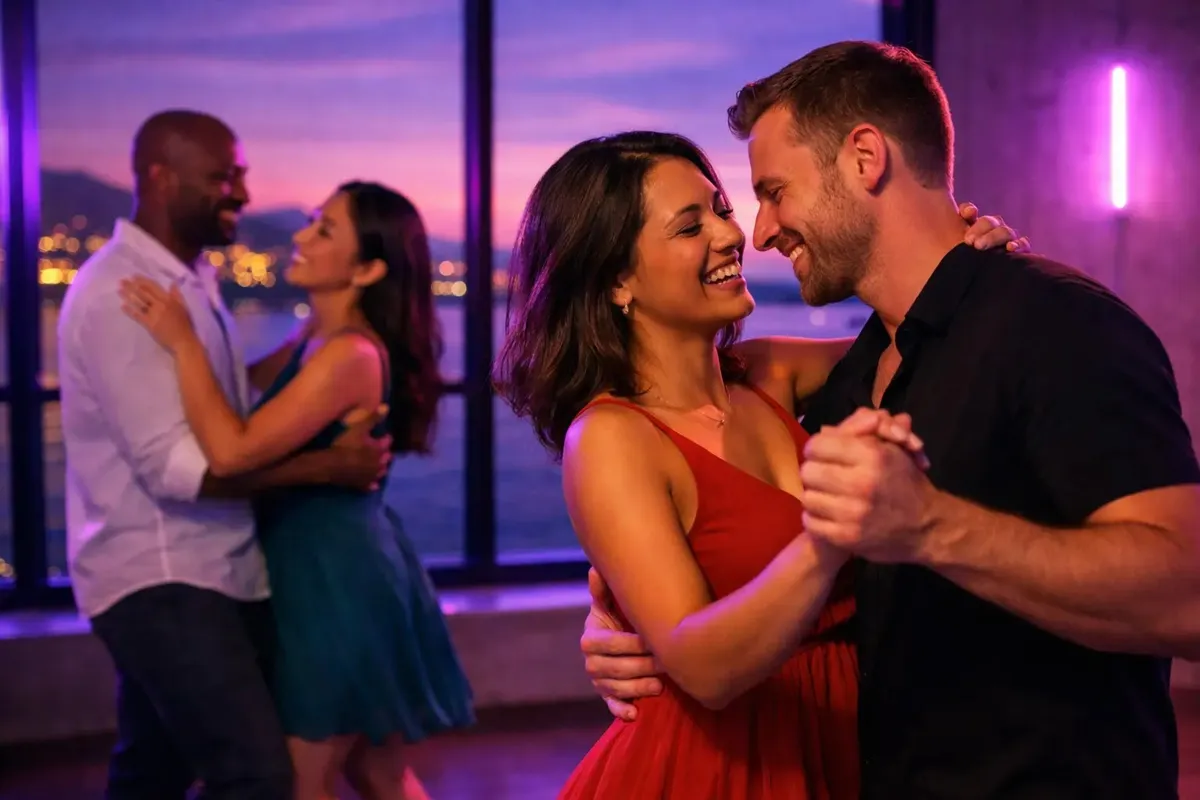
The music begins, one partner steps forward, the other responds, and suddenly there is something to work with: a rhythm, a shared direction, a small conversation through the hands and body. Private salsa lessons for couples make room for that conversation. There is no need to arrive with routines memorized or a fixed idea of who should lead. We begin with the movement that is present, then build from there.
Salsa has heat, play and clarity. Its basic structure is accessible, yet the dance can keep opening for years through timing, turns, musical detail, connection and expression. A private lesson gives the two of you time to understand what you are doing, rather than simply trying to keep up.
Why learn salsa together in a private lesson?
A couple shares the same music but not always the same learning process. One person may hear the beat immediately while the other needs to feel it through a repeated step. One may love a fast turn; the other may first want a clearer frame and more time to settle into the rhythm. In a private setting, both approaches have space.
I shape the lesson around the two people in front of me. That might mean beginning with the basic step and finding the count in the percussion. It might mean returning to salsa after years away, polishing lead and follow, or working on combinations that feel clean and exciting rather than hurried. The goal is not to copy an image of salsa. It is to find a way of dancing it that feels natural in your bodies and alive in the music.
Private instruction also lets us slow down at the useful moment. Instead of repeating a pattern before it has landed, we can look at why a turn pulls off balance, where the connection disappears, or how a small change in weight makes the next movement easier. Technical detail is not there to make dance stiff. It gives freedom to the movement.
Private salsa lessons for couples: what we work on
Salsa is often introduced through counts, but counting is only one doorway. The sound of the music, the transfer of weight through the feet, the response of a partner and the shape of the body all carry rhythm. I use explanation, demonstration, repetition, imagery and humour as needed. Sometimes the answer is a clear technical adjustment. Sometimes it is taking one quieter step and listening again.
Finding the pulse before adding patterns
The first useful skill is knowing where you are in the music. We establish the basic rhythm, then make it physical: stepping with intention, arriving over the standing leg, and allowing enough time to change weight. From there, breaks, turns and travelling movements have somewhere to go.
No experience is needed, and no one needs to prove that they have “good rhythm” before beginning. Rhythm is a skill that develops through listening and practice. A simple pattern danced on time, with ease and attention, has far more life than a complicated one chased through the music.
Lead, follow and partner response
Leading and following are shared physical skills, not fixed identities. Either partner may explore either role, and the language of the dance remains the same: clear intention, useful tone through the connection, attention and response.
A lead does not mean pulling someone through a move. A follow does not mean guessing. Good partner dancing has a conversation inside it. One person offers information through the body; the other receives it and answers in real time. We work with handholds, frame, direction, rotation and distance so that the movement feels more clear, comfortable and connected.
There is a practical trade-off here. Too much pressure makes the dance heavy. Too little can leave the movement vague. The right amount changes with the step, the speed of the music and the people dancing it. Discovering that range is part of the pleasure.
Turns, combinations and the pleasure of detail
Once the foundation is steady, salsa offers plenty of room for play. We might add turns, cross-body movement, changes of place, wraps, hand changes or a short combination that gives you several ways to move through a song. The pattern itself matters less than how it feels: balanced, musical and clear between you.
For couples who want a bigger visual moment, we can explore more dramatic movement at an appropriate scale. A well-placed dip, a sharp turn or a change in level can create real glamour and wow. Those details need preparation, timing and control. They are most effective when the basic movement underneath them is secure, rather than treated as a shortcut to looking impressive.
A lesson should fit the music you want to dance to
“Salsa” covers a wide musical and movement landscape. Some songs invite a smooth, measured feel. Others have faster percussion, punchy breaks and a more urgent energy. The approach changes depending on whether you are drawn to social salsa, a particular song, a slower groove, a bright and lively style, or choreography for a special occasion.
If you want to feel more at home dancing socially, we can focus on adaptable foundations: how to begin, how to return to the basic step after a turn, how to stay connected when something unexpected happens and how to keep the dance enjoyable without relying on a long sequence.
If a performance or celebration calls for a planned piece, the work becomes more specific. We can shape an entrance, a clear opening phrase, highlights in the music, transitions and an ending that feels like it belongs. Some couples want a few confident movements and a finish. Others want fuller choreography with texture, drama and memorable accents. Neither choice is more legitimate. The right scale is the one that suits the music, the time available and the way you want to move together.
What to expect in the studio
Lessons take place one couple at a time in my private Mount Pleasant studio in Vancouver. That privacy changes the atmosphere. There is room to ask questions, repeat a difficult section and take the time needed to let a new movement settle.
Wear clothing that allows you to move. Shoes that stay securely on the feet and allow some ease of turning are helpful, though the best choice depends on the floor and what you already own. Bring the music you are curious about if a particular song is part of the reason you are coming. We can work with it directly, or use it to understand the kind of salsa feeling you want.
You do not need to prepare a performance before the first lesson. Arrive with a question, a favourite song, a wish to learn something new, or simply an openness to move. I will meet you at the actual starting point.
How to make progress between lessons
A few minutes of focused practice often goes further than a long session of half-remembered steps. Put on one song, find the basic rhythm together and repeat a single piece of material with care. First without hands, if needed, so each person can feel the timing independently. Then reconnect and notice whether the movement still has ease.
Keep the practice small enough that it stays enjoyable. If a turn is not working, return to the step before it. If the count vanishes, listen for the pulse and walk it out. Salsa does not ask for constant complexity. It asks for presence.
The most satisfying dances are not always the flashiest ones. They are the ones where the music is audible in the body, the connection has clarity, and both people have room to respond. That is where salsa starts to feel less like a set of instructions and more like something the two of you are making together.
Move • Connect • Come Alive.